
Quick answer
Local SEO for law firms comes down to three things: the exact terms clients type into Google, a Google Business Profile that outweighs the firms next door, and a homepage that earns trust within a few seconds. We measured all three on a real firm: at none of the 49 points checked around its city did it rank in the top 3, and at the time of measurement it had 3 reviews against 53 for the strongest competing firm.
The case: one law firm, measured live
In the video, you can watch us measure the Google visibility of Jakober Rechtsanwälte in Stuttgart, Germany, live. The firm's name and its practice areas already stand in the video's public title, so naming them here adds nothing that wasn't already public.
We ran the scan on 2026-11-15 with a search term from the firm's core practice: the German equivalent of "copyright lawyer Stuttgart." The grid had 49 points, 7 by 7, across a 5 km radius around the city centre. At every point, we checked whether the firm appeared in the top 3 of Google's Maps results, because that's where most inquiries actually start. Everything after that gets noticeably less attention in practice.
Want to know where your own firm or business stands on Google? The same check is free: local visibility audit.
Step 1: what clients actually search for
National demand vs. one city: what the numbers mean
Here is how often people searched for this firm's practice areas, on average over the last 12 months, nationwide in Germany:
| Search term | Searches per month (Germany) |
|---|---|
| trademark lawyer | 590 |
| copyright lawyer | 590 |
| trademark filing cost | 260 |
| unfair-competition cease-and-desist letter | 90 |
| copyright cease-and-desist letter | 70 |
| copyright lawyer, Stuttgart | 20 |
Add the city, and the number for that exact term drops to 20. For the trademark version of the same search with the city added, Google reports no figure at all. That doesn't mean nobody searches it. It means Google doesn't report reliable data for a combination that narrow. The demand that actually counts sits in the nationwide terms without a city attached, not in the narrow combination with the place name.
Practice area and city belong in the main heading
The firm's practice-area pages run roughly 1,350 to 1,450 words, with real substance, and already name the city in the page title. The homepage, though, shows three main headings, and none of them names a practice area or the city. Of 26 measured pages, 15 have no main heading at all. In standard SEO practice, a page's main heading is one of the strongest signals of what the page is actually about, for Google and for AI search alike. A homepage with no practice area and no city in its main heading gives up exactly the terms clients are typing.
Here's how to check your own site: open your homepage and read only the main heading, the way a client would who's landing on it for the first time. If your practice area and your city aren't there, replace the heading with a short sentence that names both. State your practice area and location plainly instead of a slogan.
Then go through every other page on your site that still has no heading of its own, and give it one that matches the question that page is meant to answer.
One more thing worth checking: a narrow, city-specific term showing no figure at all in Google's own tools doesn't mean you should ignore it. It usually means the volume is real but too small for Google to report reliably on its own, which is common for anything combining a practice area with a single city. Autocomplete and the live search results page still show you whether people search that way, even when the volume tool itself comes back empty.
Step 2: why other firms rank ahead in the map
What the measurement found
At none of the 49 points did the firm rank in the top 3. In the top 20, it appeared at 38 of 49 points, which means it was missing entirely at 11. The average rank came out to 16.29. At the city centre itself, it ranked 18th.
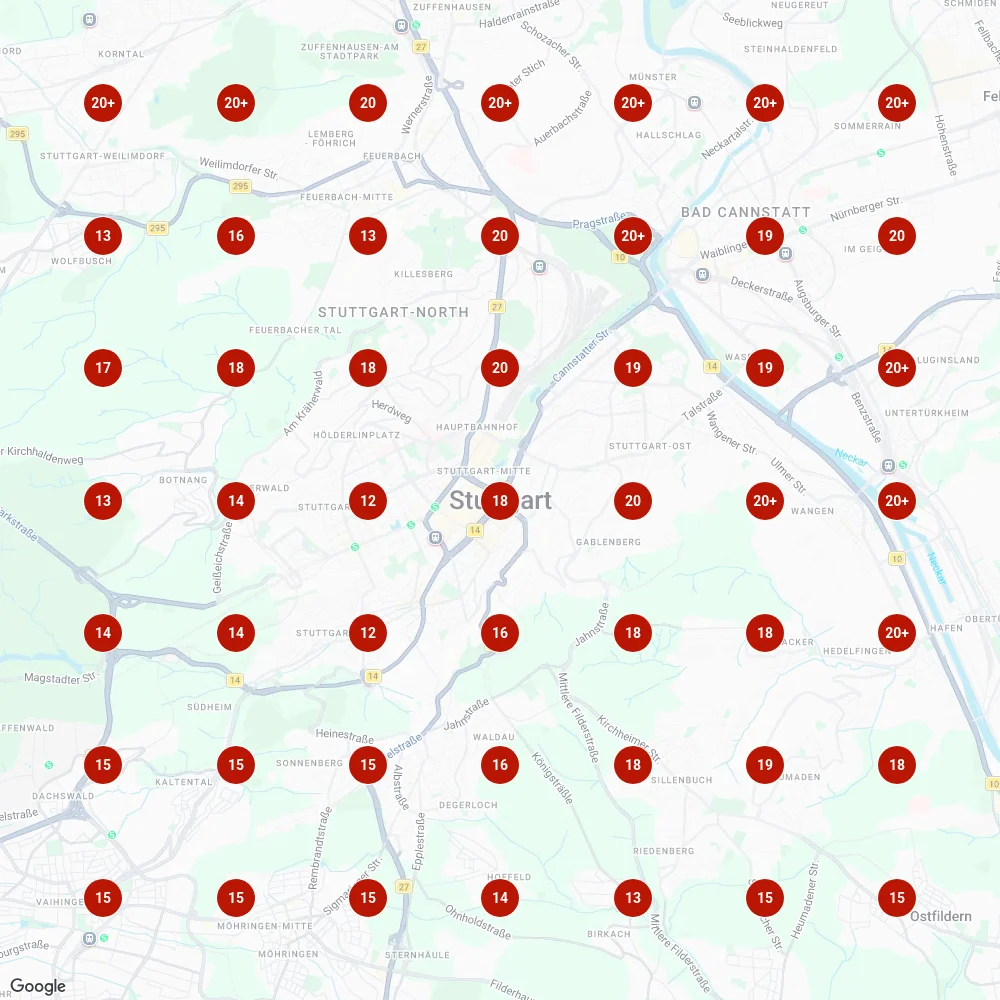
What the firms ahead do differently
Four firms ranked in the top 20 at all 49 points. They sit between 0.5 and 8 km from the city centre; the measured firm itself sits 1.3 km out. So distance doesn't explain the gap. Category doesn't either: all four show the same main Google category as the measured firm, "Attorney," and none of them has added a second category for its specific practice area. What differs clearly is reviews:
| Reviews | Distance from city centre | Main category | |
|---|---|---|---|
| Measured firm | 3 | 1.3 km | Attorney |
| Four firms ahead | 17 to 53 | 0.5 to 8 km | Attorney |
The measured firm's 3 reviews carry a 5.0 average, so the rating itself isn't the problem. The newest review is about 2 months old, the one before that about 2 years old: a 5.0 average on 3 reviews like these sits far below the 17 to 53 reviews the four firms ahead of it carry.
The strongest of the four firms ranks in the top 3 at 77.55% of the 49 points. More on improving your Google Maps ranking.
Want the same picture for your own location, without driving around to 49 points yourself? Open Google Maps on your phone, logged out, and search your most important term together with your city. Check the result at your own address, then a few kilometers further out, in several directions. If your listing disappears entirely out there, you're seeing the same effect our grid shows, just at a coarser scale.
Do you recognize this pattern in your own firm or business? Book a free call
It takes 15 minutes and costs nothing. You are not committing to anything.
Google Business Profile for law firms: six changes
Reviews: a routine, not a coincidence
The analysis points to six concrete changes to the firm's Google listing: a matching second category for its practice area, each practice area listed individually as its own service, a fixed routine for collecting new reviews after every closed case, a reply to every single review, current photos, and short, regular posts.
Law firms face a particular wrinkle with reviews: clients often don't want to appear under their full name or with details about their own case attached. A review routine for a law firm can account for that, for example by asking for a review that doesn't require any case details and leaves the choice of displayed name up to the client.
Here's how to put the routine into practice: after every closed case, send a short message with the direct review link to your Google Business Profile. Put a fixed slot on your calendar, say weekly, to go through open review requests and any new, unanswered reviews. Reply to every new review within a few days. Keep the reply short and leave out case details, and answer the critical reviews too, not only the positive ones.
Add the extra category under business information in your Google Business Profile. Give each individual practice area its own entry under services.
Your Google Business Profile isn't the only place a client or a search engine checks you. Legal directories and your own state bar listing are a second, separate signal: the same firm name, address and phone number showing up consistently across them tells Google your firm is a real, established presence in its city, not only a single profile it hasn't cross-checked anywhere else. A firm with an outdated or inconsistent entry on even one of these directories is working against its own Google Business Profile, not alongside it.
None of this needs to wait for a slow quarter. A review request takes a minute to send, a service entry takes a minute to add, and a short post describing a recent case result, where that's appropriate to share, takes a few minutes to write and publish. The firms ranking ahead of the measured firm in this case didn't necessarily do more work overall. They did this specific, small set of things consistently, case after case, instead of once and then not again.
What advertising rules generally allow
We're not naming one country's statute here, because we didn't check your own jurisdiction's specific rules today. In most places, the general principle looks similar: factual information about a lawyer's own services is normally allowed, while advertising aimed at winning one particular case is usually restricted or barred outright. For this specific case, the German rule is section 43b of the BRAO, the German lawyers' code of conduct, which permits advertising that informs factually about a lawyer's professional activity in form and content, as long as it isn't aimed at securing one particular mandate. This section is general information, not legal advice, and not an assessment of any individual case.
Step 3: the first 5 seconds on a law firm's website
The 5-second test
Visitors decide within the first 5 seconds whether they stay. The test asks five questions: What does this firm offer? Where is it located? Why this firm? How do I book an appointment? Who's behind it?
What's missing on the first screen
On the measured firm's site, the first screen answers only the first question: "Intellectual Property." The city appears only in the page title, not on the first screen. There's no star rating or review count as visible proof, no booking button, and no phone number on the first screen. No name in sight. Overall, the homepage scored 13 of 44 points on the test. That lines up with another finding: the site has no contact form and no dedicated contact page; contact runs only through email links and phone numbers in the footer. The firm's own Google reviews appear nowhere on the site itself.
A first screen that fixes this shows the practice area and city in the main heading, a real photo of the lawyer, the star rating with the review count, a booking button, and a line about confidentiality, without any promise about how a specific case will turn out.

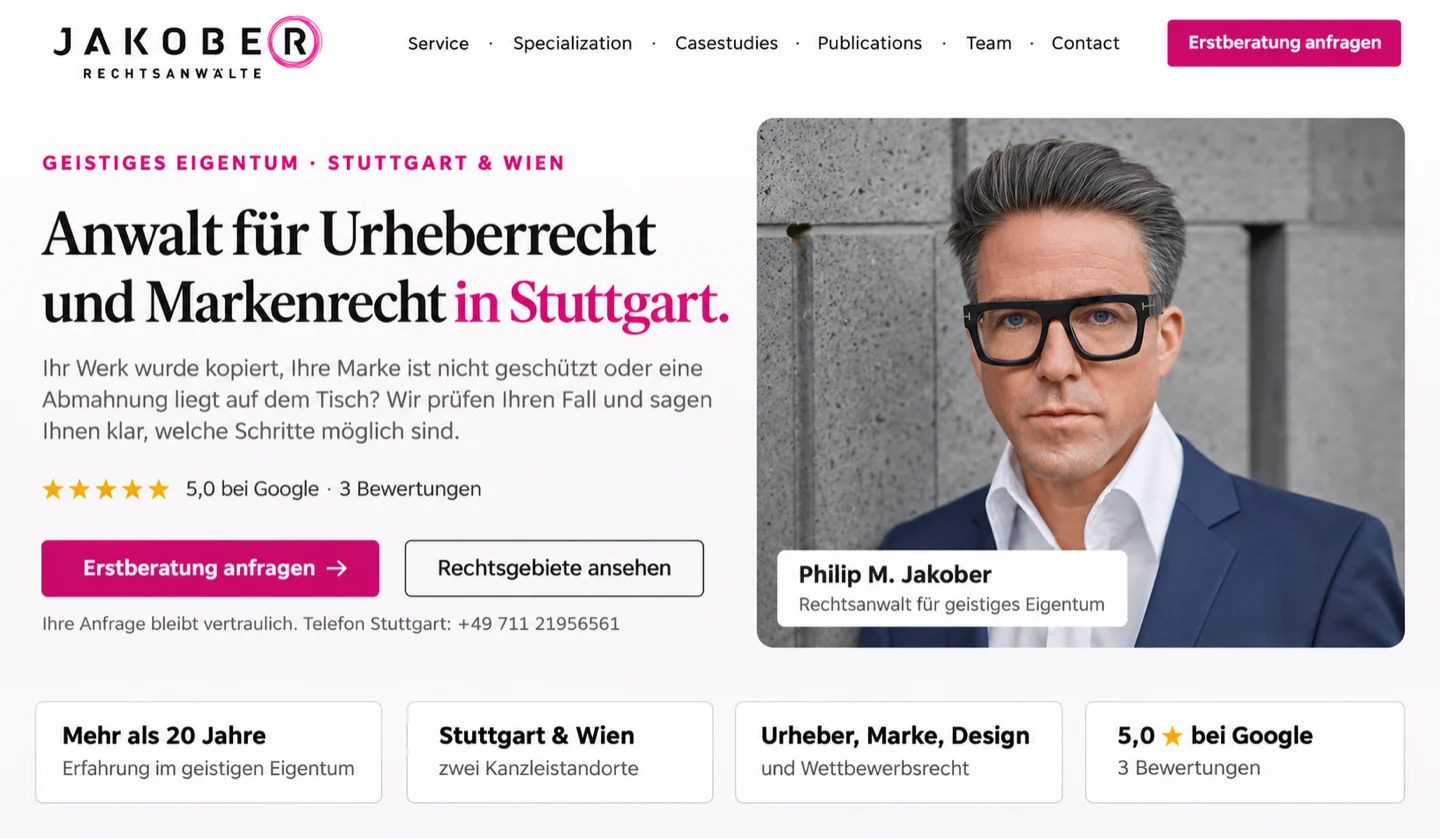
741's draft shows one way a first screen like this could look. It's a proposal, not something the firm has implemented. At the same search traffic, a clearer first screen can make a large difference in how many visitors turn into inquiries, because the same visitors see faster what's on offer and how to book.
Here's how to test your own page: open it on your phone, the way a client would see it for the first time. Read only the top screen, without scrolling, and ask yourself whether you can answer each of the five questions immediately. Every question left open costs you visitors who would otherwise have called or filled out a form.
Then check whether a contact form or contact page even exists, and whether your Google reviews are visible on your own website too, not only on Google itself.
One detail is easy to miss here: a strong review count on Google does nothing for a visitor who lands on your website first and never sees it. Pulling the same star rating and review count onto your own homepage, even as a small widget near the top, closes that gap without any change to your Google profile itself.
HTTPS was active, and the homepage answered in about 1.7 seconds on average, measured as time to first byte, both measured 2026-11-15. Google Analytics and Google Tag Manager weren't installed on the homepage, though, so the firm had no way to measure how many visitors actually called or filled out a form.
Content for law firms: six pages that meet real demand
From search term to page
The analysis points to six pieces of content the measured firm is missing today: a homepage that names the practice area and city, a dedicated page for "trademark filing cost" (260 searches a month), a dedicated page for "received a cease-and-desist letter: what now?" (90 and 70 searches a month for the two related terms), a contact page with a form, a sharper homepage description, and blog posts that each carry their own heading.
A good answer page for one of these questions starts right under the heading with the short answer, in two or three sentences. Then comes the explanation, with the steps or conditions involved, and a way to ask about the reader's own case personally. That way the answer comes first. Contact follows after.
Why this matters for AI answers too
The same structure that helps classic search also helps AI answers: a clear question as the heading, a short, direct answer right under it, a visible author name. An AI search tool can only cite what's actually written on the page, not whatever knowledge sits in the firm's own head. More on visibility in AI search.
The same logic applies to the firm's reviews, not only its pages. A review that names the actual practice area, the city and the firm by name hands a search engine, or an AI system reading that review later, information it can reuse. A one-line "Great lawyer, highly recommend" carries far less of that signal than a review that happens to mention what the case was actually about, in the client's own words, without any case details being requested of them.
Local SEO for law firms or Google Ads: what comes first
The real click prices from this case: €13.96 for "copyright lawyer," €26.29 for "trademark lawyer," €17.10 for the narrower combination with the city. As a worked example, not as a result for this firm: at 20 clicks, the click cost alone runs from roughly €280 to €526, depending on the term.
That points to a simple order. Google Ads brings visitors immediately, but every single click costs money, whether or not it turns into an inquiry. So advertising only pays off once the first screen of the site already convinces (see Step 3). Local SEO brings no instant visitors, but builds a visibility over months that carries no ongoing cost per click. A firm that combines both uses Google Ads for the terms with the highest buying intent, while building out its pages and its Google Business Profile in parallel, so the same visit arrives later without an ad too.
Want to know what this looks like for your own firm or business before you put money into clicks? 741's free visibility audit shows you that in a video made for you: where you stand today and what the biggest levers are. Delivered in about 2 hours by WhatsApp and email, GDPR-compliant: local visibility audit.
Six steps you can run yourself this week
Your six steps
These six actions come directly out of the analysis in this article:
- Put your practice area and city in your homepage's main heading.
- List every practice area as its own service in your Google Business Profile.
- Ask for a review after every closed case, and reply to every single one.
- Build a dedicated page for the most-searched question in your field, for example the cost of a trademark filing.
- Set up a contact page with a form, and put a booking button on the first screen.
- Once a year, check which pages link to you and which directories list you. Fix any outdated or inconsistent entry on a legal directory or your state bar listing, and look for one or two real local partners worth linking with. More on local backlink partnerships.
How 741 helps with this
You've seen where the firm in this example loses inquiries on Google. At 741, we work through local visibility in three steps: first, a status-quo analysis of your listings, your website and your review profile. Then we build visibility, with an optimized Google Business Profile, cleaned-up business data, and content that matches your actual search terms. And we help you systematically collect reviews and keep a permanent eye on your ranking in the Google Maps pack.
On the first call, we look at your own starting point and tell you honestly where the biggest levers are, with no sales pressure.
It takes 15 minutes and costs nothing. You are not committing to anything.
Frequently asked questions
Why isn't my law firm showing up on Google?
Usually several small issues add up: clients' search terms aren't in your main heading, your Google Business Profile shows too few services and reviews, or your homepage's first screen doesn't convince anyone. In the case in this article, all three came together at once.
What are the most effective local SEO strategies for a law firm?
Put your practice area and city in your main heading, list every practice area as its own service in your Google Business Profile, and keep a steady flow of reviews coming in. All three levers together work harder than any one on its own.
What role do Google reviews play in a law firm's local ranking?
In the measured case, the four firms ranking ahead had between 17 and 53 reviews each; the measured firm had 3. Distance from the city centre and Google category were similar or identical across all four, so review count was the clearest difference. A fixed routine that asks for a review after every closed case closes that gap over time.
Are lawyers allowed to advertise and do SEO?
Yes, in most places, within limits. The general principle is that factual information about your own services is normally allowed, while advertising aimed at winning one specific case is usually restricted. Check your own jurisdiction's specific rules directly; this article states the general principle only, not the rules for any one country or state bar.
Is local SEO or Google Ads better for a law firm?
It depends on where your own website stands today. As long as the first screen doesn't convince yet, a firm pays Google Ads for clicks that less often turn into an inquiry. A convincing page first, then advertising on top of it: that way, both pay off more.
How long does local SEO take for a law firm?
There's no honest blanket promise here; it depends on local competition and on where your own site stands today. The first changes to your main heading and your Google profile can go live within a week; a follow-up measurement then shows what they actually did.
Can a law firm do local SEO itself, without an agency?
The six steps in this article are something a firm can carry out without outside help. What's usually missing is the time for ongoing upkeep: new reviews, new posts, new content for new search terms. A one-time change isn't enough, because both the Google profile and the website need continued attention over months.
Does local SEO still matter now that people search with AI?
Yes, because AI answers draw on the same foundation as classic search: a well-kept Google Business Profile and a website that explains your own practice area clearly, with sources. Without that foundation, AI search has nothing to cite either.
About Martin
I'm Martin Drendel, Founder of 741 Studio, for over ten years in digital marketing for local businesses. This analysis shows the firm's state as of 2026-11-15, last checked for this article on 2026-11-18.
It takes 15 minutes and costs nothing. You are not committing to anything.
Prefer a lower first step? Start with the free local visibility audit instead.