
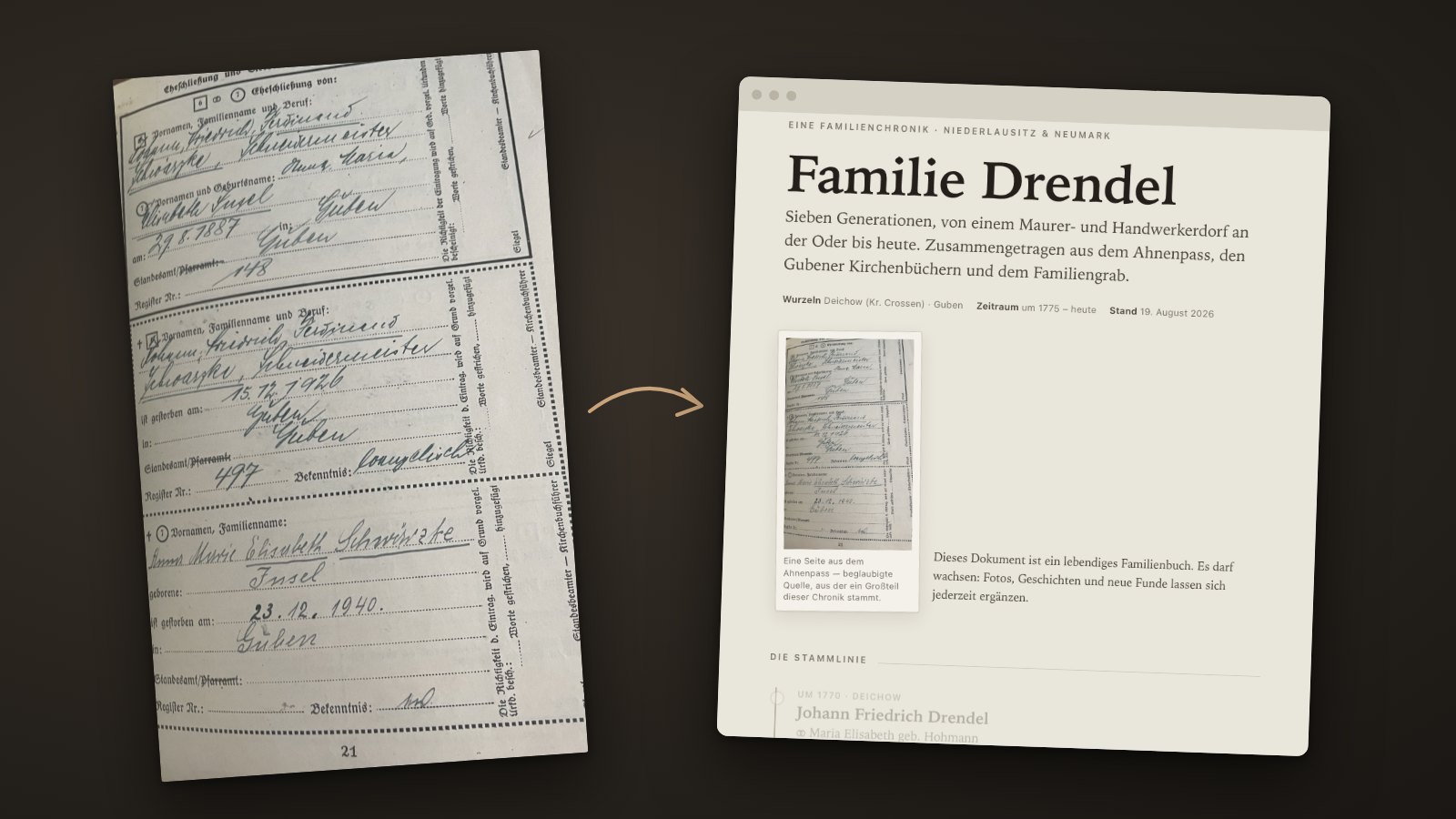
In June 2022 I took photos of my grandfather's Ahnenpass. 45 pages, tightly written, in a script almost nobody reads today. Then the photos sat on my phone for four years.
This summer I opened them again. Who were these people? I wanted to know. The result is a website my family now keeps up together.
This post shows how it went, which sources are free and where the limits are. And why I build pages like this for other families too.
What an Ahnenpass is
The Ahnenpass dates from the 1930s. The Nazi state used it to demand proof of descent. Registry offices and parish offices entered births, marriages and deaths and certified them with a stamp.
The purpose was dark. For family research the booklet is still often the densest source in the house. Ours names 30 ancestors, most of them with a date and a place.
An Ahnenpass is a copy, though. Clerks made mistakes and some fields stayed empty. Ours is missing 19 dates of death.
Step 1: Translate the old German handwriting
The Ahnenpass is written in Sütterlin and Kurrent, the old German scripts. I transcribed all 45 pages with the help of AI.
That is faster than doing it by hand. You still cannot trust the result blindly. Three rules worked for me:
- Mark every uncertain reading. Do not guess.
- Check place names against a historical gazetteer. Many of our villages are in Poland today and have new names.
- Check every important entry against the original record later.
The result was a list across seven generations. The oldest ancestor with a known date of birth was born in 1775.
Step 2: Check German church records online
I wanted to see the originals. Many church books and civil registers from the former German eastern territories are held in Polish state archives today. The portal is szukajwarchiwach.gov.pl and it is free.
The records of our home town are fully scanned: 18,898 pages from 1612 to 1944. There I found:
- my great-grandparents' marriage entry from 1925
- my great-grandfather's death entry from 1936, with the cause of death and the cemetery
- my great-grandmother's birth certificate from 1901, with the hour and the address
I learned two things on the way. Some years have a name index, others you read page by page. And the same surname does not mean the same family. Our town had at least four households with my great-grandmother's surname. Only the parents named in the record show who belongs to whom.
Step 3: Search historical address books
The German society for computer genealogy (CompGen) runs a database of historical address books. Volunteers typed them up, and you search by surname.
The 1930 address book of our town lists an uncle we only knew from stories. He lived in one house with his father and his grandfather. It also gives my great-grandfather's job in that year. No certificate had it.
Step 4: Write down what is wrong, too
Some registers are lost. My great-grandfather's grave is gone, because the cemetery was rebuilt after 1945. The archive wrote to me which books are missing.
I also misread something: one street name was wrong on the page for months. The 1930 address book exposed the error. I corrected it and noted the correction.
That is why the page has a research log. For every entry it says when I found it and which source it comes from.
Step 5: A page that belongs to the family
The chronicle is a single web page. It shows:
- the main line as a timeline
- the connected families, each with its own page
- the original documents as images
- a guestbook where relatives add what they know
- a vote on a family crest
I sent the link around the family. Whoever knows something adds it. The page grows with every conversation.
This is what ours looks like (in German): see the example version of our family chronicle
Where the limits are
Not every line can be traced further. Three hurdles come up almost every time:
- Access periods. In Germany, birth registers are closed for 110 years, marriage registers for 80 years and death registers for 30 years. Before that only close relatives get a certificate.
- Lost books. War and relocation left gaps. In our case the birth register for the second half of 1935 is missing.
- Books without an index. Then the only way is to read, page by page.
I build this for your family too
An Ahnenpass, a family register, old certificates or a few names and places are enough to start.
This is how it works:
- You send me photos of your documents.
- I transcribe the handwriting and build your family page from it.
- You manage the page and send the link to your relatives. They can submit entries.
- I run the names from your book through archives, registers and address books at regular intervals. New finds go on the page with their source.
Living people appear on the page only with their consent.
Common questions
Can AI read Sütterlin?
Yes, well enough for a first version. It sometimes misreads names and places. That is why I check important entries against the original.
What does the archive search cost?
The scans in the Polish archive portal and the address book database are free. Certificates from a German registry office cost a fee. For books that are not online, archives offer a paid search.
My family comes from Silesia, Pomerania or East Prussia. Does this work?
Often, yes. Many books from these regions are in Polish state archives. How much is online depends on the place.
Does the page stay private?
Yes. The family gets its own link. You decide who receives it.
What do you need from me?
Photos of the documents and the names you know. One phone photo per page is enough.
If you want this for your family, write to me: martin@741.studio